Herculaneum — Pompeii's Sister City Destroyed by Vesuvius
Herculaneum: The Other Buried City
When we speak of the eruption of Mount Vesuvius in 79 AD, Pompeii dominates the conversation. But there is a pompeii other city that met the same fate that day — Herculaneum (modern Ercolano), a city near pompeii that was destroyed, located just 20 kilometers northwest, even closer to Vesuvius. Often described as a pompeii similar city, Herculaneum is in many ways the more remarkably preserved of the two, offering unique insights that Pompeii cannot match.
History of Herculaneum
According to legend, Herculaneum was founded by the Greek hero Hercules (Heracles) upon his return from one of his twelve labors. In reality, the city was probably founded by the Osci people in the 7th century BC, similar to Pompeii. It came under Greek cultural influence, then Samnite control, and finally Roman rule after the Social War (89-80 BC).
Unlike Pompeii, which was primarily a commercial and agricultural center, Herculaneum developed as a residential and resort town favored by wealthy Romans. Its position on a promontory overlooking the Bay of Naples made it an attractive location for luxurious seaside villas. The city's population at the time of the eruption was approximately 4,000-5,000 — significantly smaller than Pompeii.
The Eruption at Herculaneum
Herculaneum's experience of the eruption of 79 AD was dramatically different from Pompeii's. Located northwest of Vesuvius — upwind from the prevailing wind direction — Herculaneum received very little of the pumice fall that buried Pompeii during the first phase of the eruption. This may have given Herculaneum's residents a false sense of security.
However, when the eruption column collapsed in the early hours of August 25, the pyroclastic surges that flowed down the volcano's slopes hit Herculaneum first and with devastating force. The city was buried under approximately 20 meters (65 feet) of superheated volcanic material — far deeper than Pompeii's 4-6 meters. The heat was so intense that it carbonized (rather than destroyed) organic materials like wood, food, and even papyrus scrolls.
The Boathouses Discovery
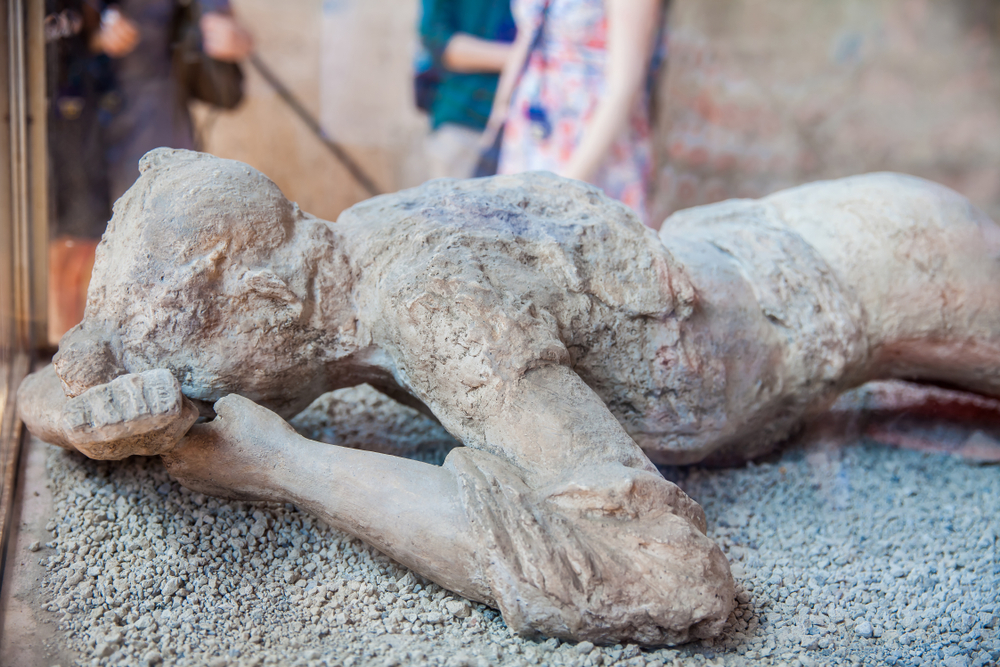
For many years, it was believed that most of Herculaneum's population had escaped before the surges arrived. This theory was overturned in the 1980s when archaeologists discovered the remains of over 300 people huddled in the arched boathouses (fornici) along the ancient beach. These individuals had apparently fled to the waterfront hoping to escape by sea, only to be killed instantly by the first pyroclastic surge.
Why Herculaneum Is Special
Superior Preservation
The depth and nature of Herculaneum's burial created preservation conditions unlike those at Pompeii:
- Wooden structures survive intact, including doors, window frames, beds, and even a wooden cradle
- Carbonized food has been found, including bread, eggs, figs, and walnuts
- Papyrus scrolls from the Villa of the Papyri — the only intact library recovered from the ancient world — contain philosophical texts that scholars are still working to unread using advanced imaging technology
- Upper stories of buildings are preserved, something almost never seen at Pompeii
- Organic materials like rope, textiles, and leather have survived in carbonized form
The Villa of the Papyri
The most famous building in Herculaneum is the Villa of the Papyri, an enormous luxury villa believed to have belonged to Lucius Calpurnius Piso Caesoninus, Julius Caesar's father-in-law. The villa contained a library of over 1,800 carbonized papyrus scrolls, primarily works of Epicurean philosophy by Philodemus of Gadara. Modern technology, including X-ray phase-contrast tomography, is being used to read these scrolls without unrolling them.
Visiting Herculaneum
Herculaneum is an excellent complement to a visit to Pompeii. The site is smaller and more manageable, can be thoroughly explored in 1.5 to 2 hours, and is generally much less crowded.
| Detail | Information |
|---|---|
| Address | Corso Resina 187, Ercolano |
| Hours | 08:30-19:30 (summer), 08:30-17:00 (winter) |
| Admission | EUR13 single / EUR22 combo with Pompeii |
| Getting there | Circumvesuviana to Ercolano Scavi station (10 min walk) |
| Best for | Visitors interested in detailed preservation and intimate scale |
Pompeii vs. Herculaneum
| Aspect | Pompeii | Herculaneum |
|---|---|---|
| Size | 66 hectares | 12 hectares |
| Population | ~11,000 | ~4,000 |
| Burial depth | 4-6 meters | Up to 20 meters |
| Excavated | ~66% | ~25% |
| Best for | Scope, urban planning, public buildings | Detail, organic preservation, intimacy |
| Crowds | Heavy | Moderate |
| Visit time | 3-5 hours | 1.5-2 hours |
Both sites are extraordinary and together provide a complete picture of Roman life in the Bay of Naples region. If you have time, visiting both is highly recommended.
Frequently Asked Questions
What is the difference between Pompeii and Herculaneum?
While both were destroyed by Vesuvius in 79 AD, they differ in preservation. Herculaneum was buried under 20 meters of volcanic material (vs 4-6 meters for Pompeii), which better preserved organic materials like wood, food, and papyrus scrolls. Herculaneum was also wealthier and smaller (about 4,000 residents vs Pompeii's 11,000).
Can you visit both Pompeii and Herculaneum in one day?
Yes, it is possible to visit both sites in one day, especially with a combo ticket (EUR22). Herculaneum is smaller and can be seen in 1.5-2 hours, while Pompeii needs 3-5 hours. Start early at one site and travel to the other after lunch. They are about 20 km apart, connected by the Circumvesuviana train (about 20 minutes).
Is Herculaneum worth visiting?
Absolutely. While less famous than Pompeii, many archaeologists consider Herculaneum the more impressive site because of its superior preservation. You can see intact wooden furniture, carbonized food, and two-story buildings with their upper floors still standing. It is also far less crowded than Pompeii.