History of Pompeii — From Ancient Origins to Modern Discovery
The Story of Pompeii
The pompeii city history spans more than 2,700 years, encompassing its origins as a small settlement, its rise to a prosperous Roman city, its catastrophic destruction in 79 AD, its long burial, and its modern rediscovery that transformed our understanding of the ancient world. If you have ever wondered "pompeii city what happened," this page serves as your starting point for exploring each chapter of this remarkable pompeii city history.
Pre-Roman Origins (7th–3rd century BC)
Pompeii's story begins centuries before Rome's dominance. The site was first settled by the Osci people around the 7th century BC, who chose the location for its strategic position near the mouth of the Sarno River and its fertile volcanic soil. The city came under strong Greek cultural influence during the 6th and 5th centuries BC, as Greek colonies like Cumae and Neapolis (Naples) dominated the region.
By the 5th century BC, the Samnites, a powerful Italic warrior people from the interior mountains, conquered Pompeii and much of the surrounding region. Under Samnite rule, the city expanded significantly, and many of its oldest surviving structures — including the early versions of the Forum and several temples — date from this period.
Roman Pompeii (80 BC – 79 AD)
In 80 BC, following the Social War, the Roman general Lucius Cornelius Sulla conquered Pompeii and established it as a Roman colony named Colonia Cornelia Veneria Pompeianorum. Roman veterans were settled in the city, and Pompeii underwent rapid Romanization.
Under Roman rule, Pompeii flourished as a center of commerce and culture. The city's population reached approximately 11,000, and its economy thrived on agriculture (wine and olive oil production), trade, and manufacturing (particularly the production of garum, a fermented fish sauce that was a staple of Roman cuisine). Wealthy citizens built elaborate homes decorated with stunning frescoes and mosaics, while the city's public buildings reflected its prosperity and civic pride.
The Catastrophe of 79 AD
On August 24, 79 AD, Mount Vesuvius erupted with catastrophic force after centuries of dormancy. The eruption, which lasted approximately 25 hours, unfolded in two devastating phases. The initial Plinian phase showered the city with pumice and ash, while the subsequent pyroclastic surges killed all remaining inhabitants and buried the city under meters of volcanic material.
Approximately 2,000 of the city's estimated 11,000 residents perished in the eruption, while others had fled in the preceding hours and days. The disaster also destroyed the neighboring cities of Herculaneum, Stabiae, and Oplontis.
Read the full account of the eruption
Burial and Rediscovery
After the eruption, Pompeii was buried under 4 to 6 meters of ash and pumice. The site was not entirely forgotten — Roman writers occasionally referenced the disaster — but the exact location of the city was lost over the centuries. In 1599, architect Domenico Fontana accidentally uncovered some of Pompeii's walls while digging a water channel, but the significance of the discovery went unrecognized.
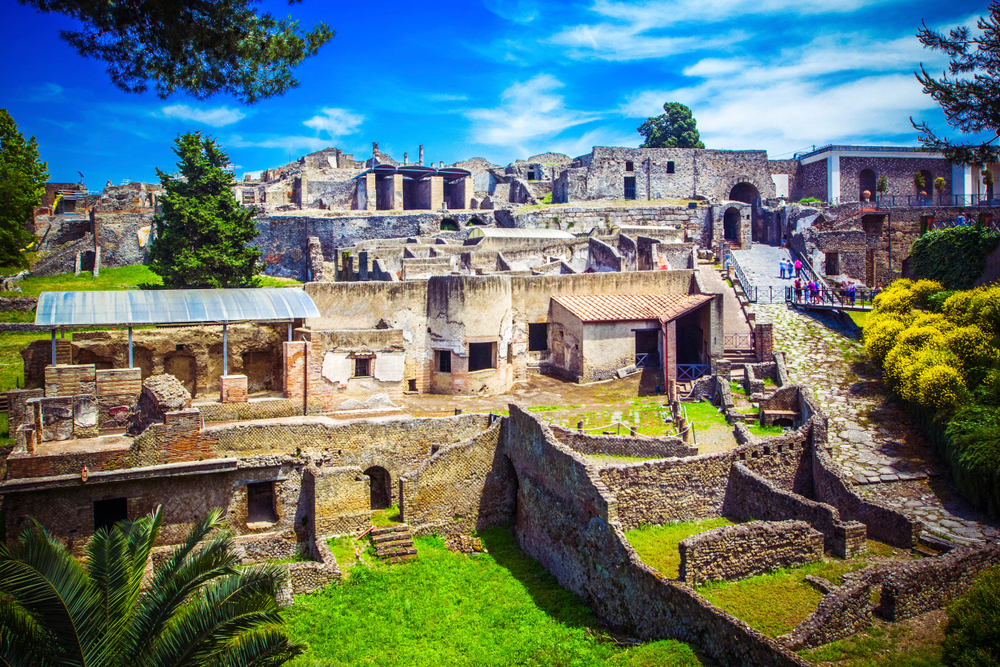
Systematic excavation began in 1748, and the site has been under continuous study ever since. Today, approximately two-thirds of the ancient city has been excavated, and new discoveries continue to be made.
Read about the discovery of Pompeii
Explore Pompeii City History
Understanding the full pompeii city history requires exploring each era in depth. For a complete pompeii city timeline, see our chronological overview below.
- The Eruption of 79 AD — Hour-by-hour account of the disaster
- Timeline of Pompeii — Chronological overview from founding to present
- Discovery & Excavation — How Pompeii was found and unearthed
- Daily Life in Roman Pompeii — What life was like before the eruption
- How Pompeii Was Destroyed — The science behind the catastrophe
- Eruption Facts — Key statistics and surprising facts about the eruption
Frequently Asked Questions
When was Pompeii founded?
Pompeii was founded in the 7th or 6th century BC by the Osci, an Italic people. The exact founding date is unknown, but archaeological evidence suggests settlement began around 600-700 BC.
How long was Pompeii buried?
Pompeii was buried for approximately 1,669 years, from the eruption of Mount Vesuvius in 79 AD until the beginning of systematic excavations in 1748.
Who discovered Pompeii?
Pompeii was accidentally rediscovered in 1599 during construction of a water channel. However, systematic excavation began in 1748 under Spanish engineer Rocque Joaquin de Alcubierre, commissioned by King Charles III of Naples.