The Eruption of Pompeii (79 AD) — Hour by Hour Account
August 24-25, 79 AD: The Day Pompeii Died
The pompeii city eruption of 79 AD is one of the most thoroughly documented natural disasters of the ancient world, thanks largely to the eyewitness account of Pliny the Younger. This devastating pompeii city volcano eruption reconstructed hour by hour below draws on Pliny's letters, archaeological evidence, and modern volcanological analysis.
The Warning Signs
In the days and weeks before the eruption, there were precursory signs that went unrecognized by the local population. Small earthquakes had been occurring with increasing frequency — a common precursor to volcanic eruptions. Springs and wells in the region dried up as groundwater was heated by rising magma. The Roman writer Cassius Dio later recorded that "many huge men quite surpassing any human stature" were seen wandering over the land — possibly a reference to hallucinations caused by volcanic gases.
The residents of Pompeii, however, had no reason to fear Vesuvius. Pompeii city before eruption was a thriving, prosperous metropolis — the mountain had not erupted in recorded memory. Earthquakes were common in the region and were attributed to the god Vulcan or to natural shifts in the earth. Life continued normally.
Hour by Hour
August 24 — Late Morning (~10:00 AM to 1:00 PM)
In the late morning, Vesuvius began to stir. The magma that had been rising through the volcano's conduit system for months finally reached the surface. The initial explosion may have been heard as a tremendous boom across the Bay of Naples.
Pliny the Younger, then 17 years old, was at Misenum, approximately 35 km across the bay, staying with his uncle Pliny the Elder, who commanded the Roman fleet stationed there. Pliny's mother pointed out an unusual cloud rising above one of the mountains across the bay.
August 24 — Early Afternoon (~1:00 PM)
The eruption column burst through the summit of Vesuvius with tremendous force. A towering column of gas, pumice, and ash rose to an estimated height of 33 km (20 miles), penetrating the stratosphere. Pliny the Younger later described it as resembling a Mediterranean pine tree — a broad trunk rising to spread into branches at the top. This description was so apt that volcanologists now use the term "Plinian eruption" for this type of event.
At Pompeii, 8 km southeast of the crater, the sky darkened as the eruption cloud spread overhead. White pumice stones began to fall, initially small and relatively harmless. The sound of the eruption was likely deafening, a continuous roar punctuated by explosive blasts.
August 24 — Afternoon (2:00 PM to 5:00 PM)
The pumice fall intensified. Lapilli (small volcanic stones) and ash accumulated on streets and rooftops at a rate estimated at 15-20 cm per hour. Roofs began to creak under the weight. Some collapsed, killing or trapping those sheltering inside.
Many residents made the decision to flee. They wrapped pillows around their heads for protection against falling stones and joined the mass exodus through the city gates and into the surrounding countryside. Others chose to stay, seeking shelter in the strongest rooms of their houses, hoping the pumice fall would pass.
At Misenum, Pliny the Elder received urgent messages from people trapped along the coast near Vesuvius. He ordered the warships of the fleet launched on a rescue mission and set sail toward the danger zone. It was an act of extraordinary courage — and it would cost him his life.
August 24 — Evening (5:00 PM to Midnight)
The pumice fall continued relentlessly. By evening, approximately 1.5 meters of pumice had accumulated in Pompeii's streets, and the upper floors of many buildings were collapsing under the load. Fires broke out as oil lamps were overturned.
The eruption column shifted during this period. The color of the pumice changed from white (indicating that the initial magma being erupted was chemically evolved and rich in silica) to grey (as the eruption tapped deeper, less evolved magma). This change in pumice composition is clearly visible in the geological layers at Pompeii.
Pliny the Elder reached the coast near Stabiae, about 4.5 km south of Pompeii. Unable to land at his intended destination due to falling debris, he put ashore at the villa of his friend Pomponianus. Despite the ongoing eruption, Pliny dined and went to sleep — either from genuine calm or to reassure his terrified companions.
August 25 — Early Morning (Midnight to ~1:00 AM)
The eruption entered its most dangerous phase. The eruption column, which had been sustained for approximately 12 hours, became gravitationally unstable. When the rate of magma eruption could no longer sustain the column's height, portions of the column collapsed, sending superheated avalanches of gas and volcanic material cascading down the slopes of Vesuvius.
August 25 — The Pyroclastic Surges (1:00 AM to 8:00 AM)
Six major pyroclastic density currents (PDCs) swept down from the collapsing eruption column:
Surge 1 (~1:00 AM): The first surge traveled primarily down the northwest flank of Vesuvius, reaching and devastating Herculaneum. Temperatures in Herculaneum were estimated at 400-500 degrees Celsius. Everyone remaining in the city was killed instantly. The surge did not reach Pompeii.
Surge 2 (~2:00 AM): A second, larger surge struck Herculaneum and its surroundings. It reached the boathouses along the ancient shoreline where over 300 people had gathered hoping to escape by sea. They too were killed.
Surge 3 (~3:00-4:00 AM): Reached the outskirts of Pompeii but did not penetrate the city walls with lethal force.
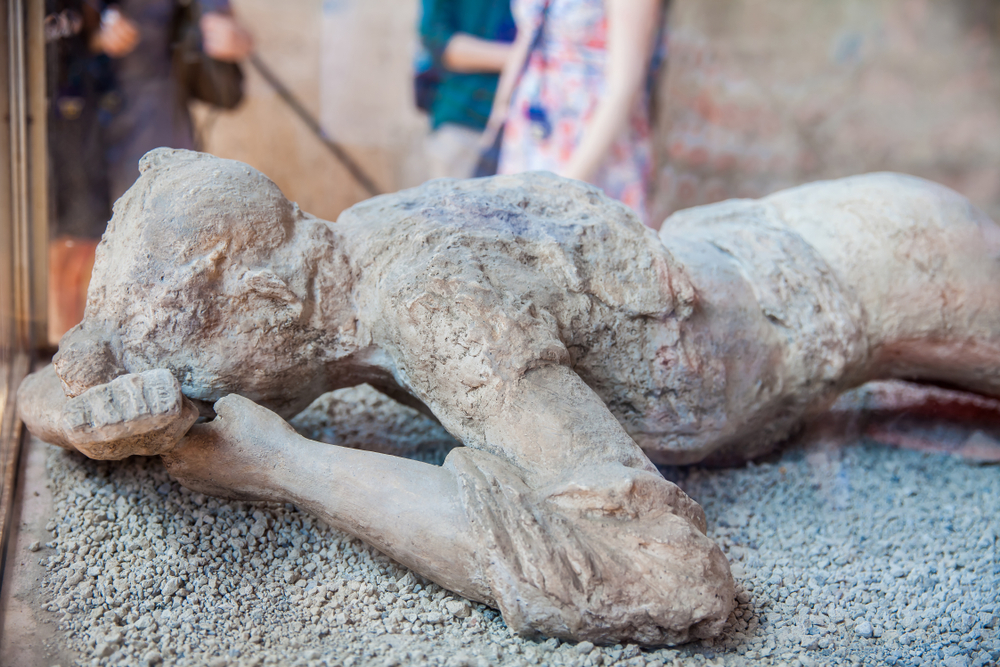
Surge 4 (~6:30 AM): This was the first pyroclastic surge to strike Pompeii with full force. Traveling at speeds estimated at up to 300 km/h, with temperatures of 300-350 degrees Celsius, it overtopped the city walls and swept through the streets. Everyone remaining in the city — those sheltering in buildings, those attempting to flee through the streets — was killed instantly by thermal shock.
Surge 5 (~7:00 AM): A larger surge that further buried the city and extended beyond it.
Surge 6 (~8:00 AM): The final major surge, the largest and most energetic, traveled the farthest from the volcano and deposited the uppermost layers of pyroclastic material.
The Death of Pliny the Elder
At Stabiae, Pliny the Elder was awakened by the intensifying eruption. His room was becoming buried by pumice fall, and the building shook with earthquakes. The group decided to flee to the beach. With pillows tied to their heads against falling stones, they emerged into total darkness — the ash cloud blocked all light, even from torches.
On the beach, Pliny the Elder collapsed. According to his nephew's later account, Pliny had been suffering from breathing difficulties, possibly aggravated by the volcanic gases and ash in the air. When his companions returned after the surge had passed, they found his body lying on the shore, apparently dead from suffocation or cardiac arrest. He was 55 years old.
August 25 — Aftermath
By midday on August 25, the eruption had subsided. Where Pompeii had stood, there was now a gently undulating plain of grey volcanic debris, 4-6 meters deep. No building was visible above the surface. The city of 11,000 had been erased from the landscape.
At Misenum, Pliny the Younger and his mother, who had survived the more distant effects of the eruption, emerged to find the world transformed. Ash covered everything, and the sun was still dimmed. In the following days and weeks, survivors returned to the Pompeii area, some digging tunnels into the hardened ash to recover valuables from buildings whose locations they remembered.
But the pompeii city destroyed by Vesuvius was gone. When pompeii city destroyed on that fateful day in 79 AD, its precise location became uncertain within a generation. Within a few centuries, it was forgotten entirely. It would not be systematically excavated for another 1,669 years.
Frequently Asked Questions
When did Pompeii erupt?
Mount Vesuvius erupted on August 24, 79 AD (though some scholars argue for an October date based on archaeological evidence). The eruption lasted approximately 25 hours, with the most destructive phase occurring in the early morning of August 25.
How long did the eruption of Pompeii last?
The entire eruption lasted approximately 25 hours, from roughly 1:00 PM on August 24 to approximately 2:00 PM on August 25, 79 AD. The first phase (pumice fall) lasted about 18 hours, followed by the devastating pyroclastic surge phase lasting about 7 hours.
Did anyone survive the eruption of Pompeii?
Yes, the majority of Pompeii's ~11,000 residents survived by fleeing during the first phase of the eruption. Approximately 2,000 people who remained in or near the city were killed, primarily by pyroclastic surges. Pliny the Younger survived and left the only eyewitness account.