Mount Vesuvius — The Complete Guide to Italy's Most Famous Volcano
The Most Famous Volcano in the World
Mount Vesuvius (Italian: Monte Vesuvio) is arguably the most famous and most studied volcano on Earth. Rising 1,281 meters above the Bay of Naples in southern Italy, this stratovolcano has shaped human history, destroyed entire cities, and continues to pose a significant threat to the millions of people who live in its shadow. The pompeii city volcano is the defining relationship of the ancient world's most famous archaeological site. It is the only active volcano on the European mainland.
Geological Profile
Formation and Structure
Vesuvius is a somma-stratovolcano, consisting of two distinct components: the older Monte Somma caldera, which partially encircles the younger Vesuvius cone. The Monte Somma caldera is the remnant of an older, larger volcanic edifice that collapsed during a massive eruption approximately 17,000 years ago (the Basal Pumice eruption). The current Vesuvius cone has been built up within this caldera by subsequent eruptions.
The volcano sits at the convergence of the African and Eurasian tectonic plates. The subduction of the African plate beneath Italy creates the magma that feeds Vesuvius. This magmatic source lies at a depth of approximately 8 kilometers beneath the surface and is connected to the volcano's conduit system.
Key Measurements
| Feature | Measurement |
|---|---|
| Summit elevation | 1,281 m (4,203 ft) |
| Crater diameter | ~450 m (1,475 ft) |
| Crater depth | ~300 m (984 ft) |
| Base circumference | ~50 km (31 mi) |
| Distance to Naples | 9 km (5.6 mi) |
| Distance to Pompeii | 8 km (5 mi) |
Eruption History
Pre-79 AD Eruptions
Vesuvius has been active for at least 300,000 years. Before the famous eruption of 79 AD, several major eruptions shaped the landscape:
- Codola eruption (~25,000 BC) — A massive eruption that deposited ash across a wide area
- Basal Pumice eruption (~15,000 BC) — Created the Monte Somma caldera
- Mercato eruption (~6000 BC) — One of the largest known eruptions of Vesuvius
- Avellino eruption (~1800 BC) — Destroyed Bronze Age settlements; the last major eruption before 79 AD
The roughly 1,800-year gap between the Avellino eruption and the 79 AD catastrophe meant that Romans had no living memory or cultural awareness of Vesuvius as a dangerous volcano.
The Eruption of 79 AD
The most famous eruption in history began on August 24, 79 AD and lasted approximately 25 hours. The eruption was a Plinian event, named after Pliny the Younger, whose detailed letters provide the only surviving eyewitness account.
Phase 1 — Plinian Column (August 24, ~1:00 PM to midnight): A massive eruption column rose to an estimated 33 km (20 miles), ejecting pumice and ash at a rate of approximately 1.5 million tons per second. Prevailing winds carried the fallout southeast, directly over Pompeii. By evening, pumice and ash had accumulated to nearly 3 meters in the city.
Phase 2 — Column Collapse and Pyroclastic Surges (August 25, ~1:00 AM to ~8:00 AM): The eruption column became gravitationally unstable and collapsed multiple times, generating six major pyroclastic density currents (PDCs). These superheated avalanches of gas, ash, and rock traveled down the volcano's slopes at speeds up to 700 km/h with temperatures between 300 and 700 degrees Celsius.
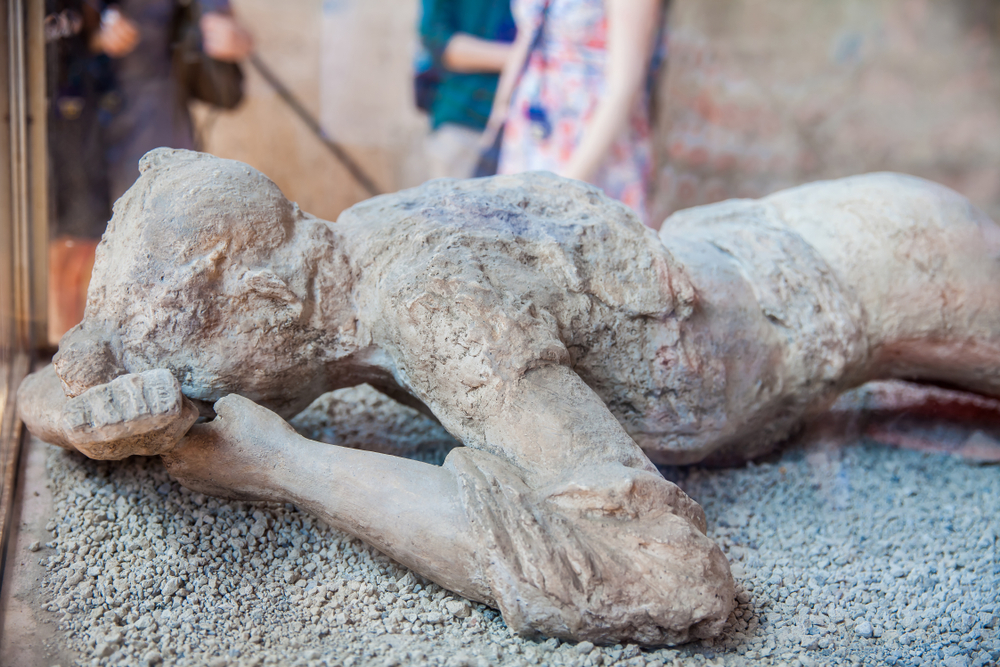
The first three surges destroyed Herculaneum (closer to the volcano). The fourth surge, at approximately 6:30 AM, was the first to reach Pompeii, killing everyone who remained in the city. The fifth and sixth surges added further layers of volcanic material.
Total energy released: Estimated at 100,000 times the thermal energy of the Hiroshima atomic bomb.
Post-79 AD Eruptions
Vesuvius has erupted at least 50 times since 79 AD. Key eruptions include:
- 203 AD — Major eruption recorded by the historian Cassius Dio
- 472 AD — Ash fell as far as Constantinople (Istanbul), over 1,200 km away
- 512 AD — Severe eruption; Ostrogothic King Theodoric exempted local inhabitants from taxes
- 1631 — The most devastating eruption since 79 AD, killing approximately 3,000-6,000 people. This eruption initiated a period of almost continuous activity lasting until 1944
- 1794 — Destroyed the town of Torre del Greco; lava flows reached the sea
- 1906 — Major eruption that killed over 100 people and devastated several towns. This eruption was powerful enough to be considered for use in calibrating the Volcanic Explosivity Index
- 1944 — The most recent eruption, occurring during World War II. It destroyed the village of San Sebastiano al Vesuvio and damaged American B-25 bombers parked at the nearby Pompeii Airfield. The eruption was filmed by Allied military personnel, providing some of the earliest film footage of a major volcanic eruption
Current Status
A question frequently asked is is mount vesuvius still active — and the answer is unequivocally yes. Many also wonder will mount vesuvius erupt again: volcanologists consider a future eruption certain, though its timing and scale remain unknown.
Since 1944, Vesuvius has been in a quiescent phase — its longest period of rest since 1631. The volcano shows ongoing signs of activity including:
- Low-level seismic activity (hundreds of minor earthquakes per year)
- Fumarolic emissions from the crater and surrounding areas
- Ground deformation detected by GPS and satellite measurements
- Elevated temperatures at fumaroles (up to 95°C at the crater)
The Osservatorio Vesuviano, founded in 1841 and the oldest volcanological observatory in the world, continuously monitors the volcano using a dense network of instruments.
Hiking Mount Vesuvius
The Trail
Visiting the crater of Vesuvius is one of the most popular excursions from Naples and Pompeii. The hiking trail begins at the parking area at approximately 1,000 meters elevation, reachable by car or bus from Ercolano (Herculaneum) or Pompeii.
The trail to the crater rim is approximately 860 meters long with an elevation gain of about 230 meters. The path is well-maintained, with a gravel surface and some paved sections. Most visitors complete the ascent in 20-30 minutes at a moderate pace.
What You'll See
At the summit, you can walk along approximately half of the crater rim, looking down into the vast crater that is roughly 450 meters across and 300 meters deep. On clear days, the panoramic views are spectacular:
- The Bay of Naples and the Tyrrhenian Sea to the west
- The city of Naples to the northwest
- The Sorrentine Peninsula and Capri to the south
- The Apennine Mountains to the east
- The archaeological sites of Pompeii and Herculaneum below
Practical Information
| Detail | Information |
|---|---|
| Admission | ~EUR10 |
| Hours | Generally 09:00-17:00 (varies by season) |
| Difficulty | Easy to moderate |
| Duration | 20-30 minutes up, 15-20 minutes down |
| What to bring | Comfortable shoes, water, sun protection |
| Best time | Early morning for clearest views |
The Danger Zone
The Italian government has established three risk zones around Vesuvius:
Red Zone (Zona Rossa): The area at highest risk from pyroclastic flows. Approximately 600,000 people live in 18 municipalities within this zone. In the event of an eruption, this area would need to be completely evacuated before eruptive activity begins.
Yellow Zone (Zona Gialla): At risk primarily from ash fall and the potential collapse of buildings under the weight of accumulated volcanic debris. Approximately 1.1 million people live in this zone.
Blue Zone (Zona Blu): At risk from lahars (volcanic mudflows) and flooding caused by volcanic activity.
The Italian Civil Protection Agency (Protezione Civile) maintains a detailed National Emergency Plan for Vesuvius, which envisions the evacuation of 600,000 people from the red zone within 72 hours of a confirmed eruption warning. Each municipality in the red zone has a "twinning" arrangement with a region elsewhere in Italy that would receive its evacuated population.
Vesuvius in Culture
Vesuvius has been a subject of art, literature, and scientific study for centuries. The volcano features prominently in the works of writers from Pliny the Younger to Mark Twain, and has been painted by artists including J.M.W. Turner, Pierre-Jacques Volaire, and Andy Warhol. The volcano's dramatic silhouette is an iconic symbol of the Naples region, appearing on postcards, wine labels, and restaurant logos throughout Campania.
The scientific study of Vesuvius has contributed enormously to the field of volcanology. The term "Plinian eruption" (for eruptions with tall, sustained eruption columns) was coined based on the 79 AD event, and the Vesuvius Observatory has been at the forefront of volcano monitoring technology since its founding in 1841.
Frequently Asked Questions
Is Mount Vesuvius still active?
Yes, Mount Vesuvius is classified as an active volcano. It last erupted in March 1944. It is currently in a quiescent (resting) phase, but seismic monitoring detects ongoing activity beneath the volcano. Volcanologists consider a future eruption certain — the question is when, not if.
How tall is Mount Vesuvius?
Mount Vesuvius stands 1,281 meters (4,203 feet) above sea level. Before the eruption of 79 AD, the volcano was estimated to have been about 2,000 meters tall, but the massive eruption destroyed the upper portion of the cone.
Can you hike Mount Vesuvius?
Yes, you can hike to the crater rim of Mount Vesuvius. The trail begins at an elevation of about 1,000 meters, reached by car or bus, and the hike to the summit takes approximately 20-30 minutes along a well-maintained path. The crater is about 300 meters deep and 400 meters across.
How many times has Vesuvius erupted?
Mount Vesuvius has erupted at least 50 times since the catastrophic eruption of 79 AD. Major eruptions occurred in 472, 512, 1631, 1794, 1906, and most recently in 1944. The volcano follows a pattern of prolonged quiet periods followed by explosive eruptions.
How many people live near Vesuvius?
Approximately 3 million people live in the greater Naples metropolitan area surrounding Vesuvius. About 600,000 people live in the designated high-risk 'red zone' on the volcano's slopes, making it the most densely populated volcanic area in the world.
What would happen if Vesuvius erupted today?
A major eruption could produce pyroclastic flows, ash fall, lahars (volcanic mudflows), and earthquakes affecting the entire Naples metropolitan area. Italian authorities maintain a detailed evacuation plan for the red zone. A sub-Plinian eruption (smaller than 79 AD) is considered the most likely scenario for the next eruption.