Eruptions of Mount Vesuvius: From 79 AD to Today
A Volcano Defined by Its Eruptions
Few mountains on Earth are as bound to a single moment in history as Mount Vesuvius. The mount vesuvius eruption of 79 AD destroyed Pompeii and Herculaneum so completely — yet preserved them so perfectly — that the volcano's name has become inseparable from catastrophe. But the eruption that buried Pompeii was neither the first nor the last time Vesuvius unleashed its power. To understand the volcano that looms over the Bay of Naples, you have to understand its long, violent eruptive history, from prehistory to its most recent awakening in 1944.
This page traces every major chapter of that history and answers the questions visitors most often ask: when did mount vesuvius erupt, how often it has done so, and whether it remains a threat today.
Before 79 AD: A Long Volcanic Prehistory
Vesuvius has been volcanically active for roughly 300,000 years, and it is far older than the city it is famous for destroying. Long before Pompeii existed, a series of enormous prehistoric eruptions shaped the landscape of Campania. The Avellino eruption of around 1800 BC — larger than the 79 AD event — buried Bronze Age settlements whose footprints, including human and animal tracks fleeing the ashfall, have been excavated by archaeologists.
Crucially, roughly 1,800 years separated the Avellino eruption from 79 AD. By the time Romans built their prosperous towns on Vesuvius's fertile volcanic slopes, the mountain had been quiet for so long that no one regarded it as dangerous. To the people of Pompeii, Vesuvius was simply a green, vineyard-covered hill. They had no living memory, and no written record, of it ever erupting.
The 79 AD Eruption That Buried Pompeii
The Two Phases of the Disaster
The mount vesuvius eruption 79 ad is the most famous volcanic event in history, and it remains the textbook example of its kind. Long thought to have occurred on August 24, recent archaeological and historical evidence — including a charcoal inscription and seasonal foods found in the ruins — suggests the eruption may actually have begun in October. Whatever the exact date, the sequence of destruction is well understood and unfolded over roughly 18 to 25 hours in two distinct phases.
In the first, Plinian phase, a colossal column of gas, pumice, and ash blasted upward to an estimated 30 kilometers (about 20 miles) into the sky. Prevailing winds carried this fallout southeast, directly over Pompeii. For many hours, pumice and ash rained down on the city, accumulating to a depth of nearly three meters. Roofs collapsed under the weight, and many of those who did not flee in time were trapped or crushed. Herculaneum, lying to the west, was largely spared this initial fallout because of the wind direction.
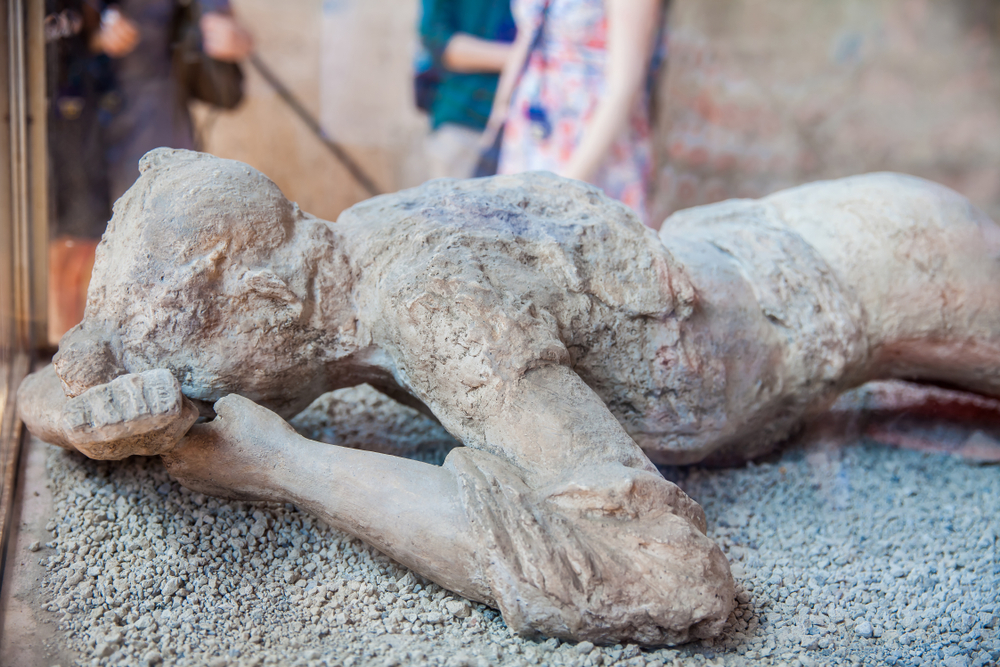
In the second, column-collapse phase, the towering eruption column became too dense to sustain itself and repeatedly collapsed. Each collapse sent pyroclastic density currents — ground-hugging avalanches of superheated gas, ash, and rock — racing down the volcano's flanks at speeds of up to several hundred kilometers per hour, with temperatures estimated between 300 and 700 degrees Celsius. The early surges obliterated Herculaneum. Later surges swept into Pompeii in the early morning, killing instantly everyone who had remained behind. These currents are what produced the haunting voids in the ash that, when filled with plaster, became the famous body casts of Pompeii's victims.
For the hour-by-hour story of that day and night, see our dedicated account of the 79 AD eruption.
Pliny the Younger: The First Eyewitness
We owe much of our knowledge of this vesuvius eruption to a teenage boy. Pliny the Younger watched the disaster unfold from across the bay at Misenum and, decades later, described it in two letters to the historian Tacitus. He recorded the strange shape of the eruption column, which he compared to an umbrella pine tree — a tall trunk spreading into branches at the top — a description so accurate that volcanologists now use the term Plinian eruption for any explosive event with a tall, sustained column.
Pliny also chronicled the death of his uncle, Pliny the Elder, a naturalist and fleet commander who sailed toward the eruption both to observe it and to rescue stranded residents. The elder Pliny died on the shore near Stabiae, likely overcome by volcanic gases. His nephew's letters remain the only surviving eyewitness account of the catastrophe and stand as the founding documents of the science of volcanology.
Later Eruptions: 472, 512, 1631 and Beyond
The destruction of Pompeii was far from the end of Vesuvius's story. The volcano has erupted at least 50 times since 79 AD, punctuating the centuries with periodic violence.
A powerful eruption in 472 AD was said to have scattered ash as far as Constantinople, more than a thousand kilometers away. Another major eruption struck in 512 AD, severe enough that the Ostrogothic king Theodoric exempted the people living around the mountain from taxes to help them recover.
The most consequential post-Roman event was the eruption of 1631, the deadliest since 79 AD. After roughly five centuries of relative calm, Vesuvius erupted with little warning, killing an estimated 3,000 to 6,000 people through pyroclastic flows, lava, and lahars. The 1631 eruption marked a turning point: it ushered in a period of nearly continuous low-level activity, with frequent smaller eruptions, lava flows, and crater glows, that would last more than three centuries.
During this long active period, Vesuvius erupted dozens of times. The eruption of 1794 destroyed much of the town of Torre del Greco and sent lava into the sea. The eruption of 1906 killed more than a hundred people and lowered the height of the summit. Each of these events reminded the growing population of Naples that they lived beside a restless giant.
The Last Eruption: March 1944
The most recent of all the vesuvius eruptions occurred in March 1944, in the middle of the Second World War, while Allied forces occupied the region. Lava flows engulfed the villages of San Sebastiano al Vesuvio and Massa di Somma, and ashfall damaged dozens of American B-25 bombers parked at a nearby airfield. Because Allied military personnel filmed and photographed the event extensively, the 1944 eruption is one of the best-documented volcanic eruptions of the early film era.
The 1944 eruption also brought to a close the long cycle of activity that had begun in 1631. Since that spring, Vesuvius has fallen silent — its longest period of dormancy in centuries.
Is Vesuvius Still Active Today?
A question almost every visitor asks is is vesuvius still active — and the answer is an emphatic yes. Vesuvius is dormant, not extinct. It is the only active volcano on the European mainland, and beneath its quiet surface it continues to show signs of life:
- Hundreds of low-magnitude earthquakes each year
- Fumaroles releasing volcanic gases from the crater and slopes
- Slow ground deformation tracked by GPS and satellite
- Elevated temperatures at vents within the crater
These signs are monitored around the clock by the Osservatorio Vesuviano (Vesuvius Observatory), founded in 1841 and the oldest volcanological observatory in the world. Today it operates a dense network of seismometers, GPS stations, and gas sensors that would detect the precursors of a reawakening — rising earthquakes and ground swelling — likely days to weeks before any eruption.
Why Vesuvius Is So Dangerous
What makes Vesuvius one of the most dangerous volcanoes on the planet is not just its eruptive style but its location. Roughly 3 million people live in the greater Naples metropolitan area within reach of its hazards, and some 600,000 live directly in the designated "red zone" on its slopes — the area most threatened by pyroclastic flows. No other active volcano on Earth has so many people living so close to it.
Because Vesuvius tends to alternate between explosive Plinian or sub-Plinian eruptions and quieter effusive lava-producing phases, the danger depends heavily on what kind of eruption comes next. Volcanologists consider a sub-Plinian eruption — smaller than 79 AD but still capable of producing deadly pyroclastic flows and heavy ashfall — the most likely scenario. Italy's Civil Protection authority maintains a national emergency plan designed to evacuate the entire red zone within 72 hours of a confirmed warning.
So while no one can say exactly when did mount vesuvius erupt next, the scientific consensus is clear: a future eruption is not a question of if, but when. For more on the volcano's structure, hiking trails, and danger zones, see our complete guide to Mount Vesuvius, and for the broader science of how it works, explore our page on the volcano and Pompeii.
Related Pages
- Mount Vesuvius — The Complete Guide — Geology, hiking, and visiting the crater
- The Eruption of 79 AD — Hour-by-hour account of the day Pompeii died
- The Volcano and Pompeii — How Vesuvius shaped the ancient city
- Herculaneum — Pompeii's neighbor, buried by the same eruption
Frequently Asked Questions
When did Mount Vesuvius last erupt?
Mount Vesuvius last erupted in March 1944, during World War II. The eruption destroyed the villages of San Sebastiano al Vesuvio and Massa di Somma and damaged Allied B-25 bombers parked at a nearby airfield. It was the most recent in a series of eruptions stretching back tens of thousands of years.
How many times has Vesuvius erupted?
Mount Vesuvius has erupted at least 50 times since the famous eruption of 79 AD, and it has been volcanically active for around 300,000 years. Major eruptions occurred in 472, 512, 1631, 1794, 1906, and 1944, separated by long quiet intervals.
Is Mount Vesuvius still active?
Yes. Mount Vesuvius is classified as an active volcano and is the only active volcano on the European mainland. It has been dormant since its last eruption in 1944, but it continues to show low-level seismic activity, fumarole emissions, and ground movement, and volcanologists consider a future eruption certain.
Could Vesuvius erupt again?
Almost certainly. Vesuvius is dormant, not extinct, and its history of explosive eruptions makes a future event inevitable in geological terms. The most likely next scenario is a sub-Plinian eruption smaller than 79 AD. Italian authorities maintain a detailed evacuation plan for the roughly 3 million people who live in the surrounding region.
How did the 79 AD eruption destroy Pompeii?
The 79 AD eruption unfolded in two phases. First, a towering Plinian column rained pumice and ash on Pompeii for many hours, collapsing roofs. Then the column collapsed into pyroclastic surges — fast-moving avalanches of superheated gas and ash — that killed everyone who remained and buried the city under meters of volcanic debris.